


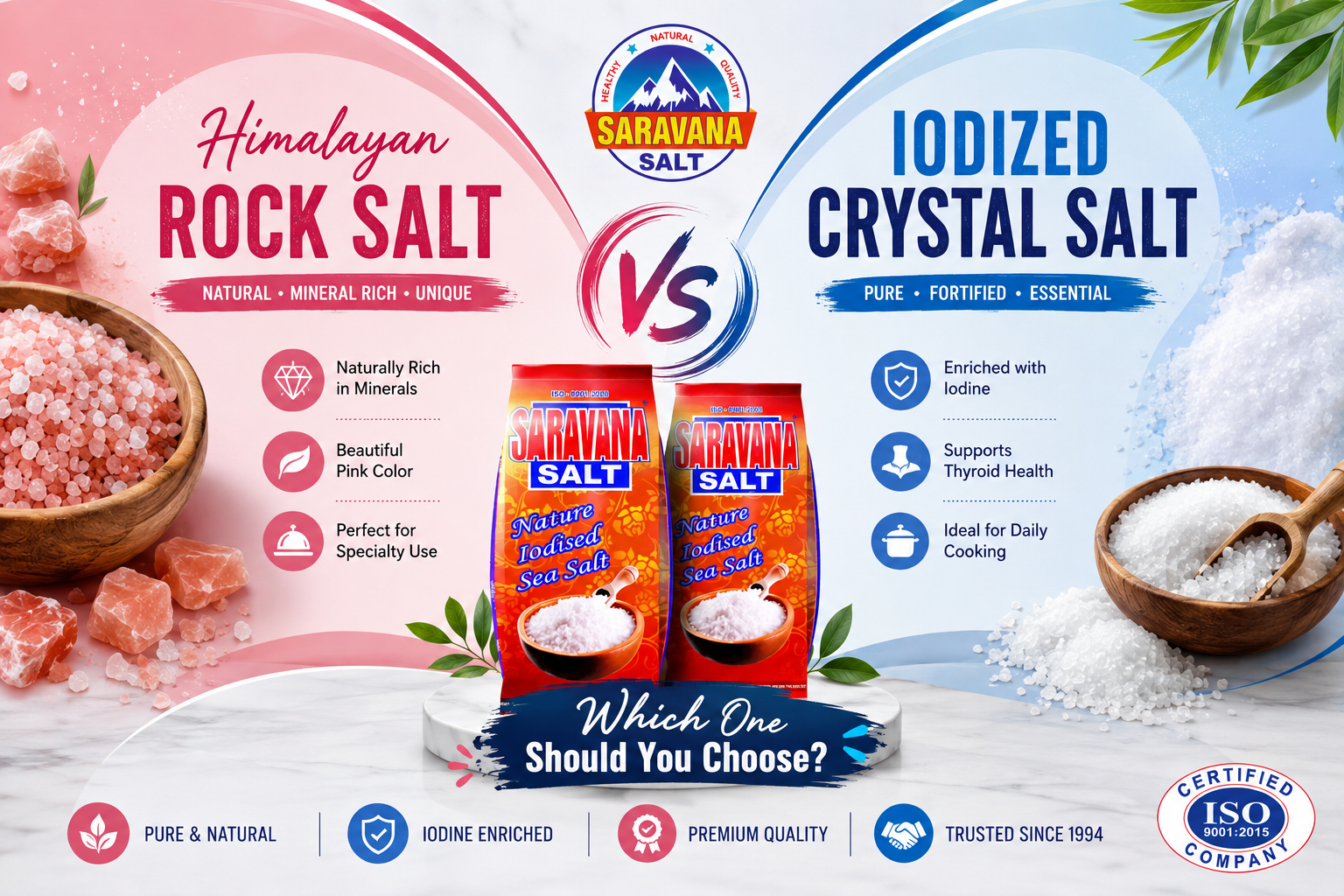
Himalayan Rock Salt vs Iodized Crystal Salt: Which One Should You Choose?
Choosing the right salt may seem like a small decision, but with so many varieties available today, consumers often wonder which option is better for everyday cooking. Himalayan Rock Salt vs Iodized Salt is one of the most common comparisons, especially among people looking for a balance between taste, appearance, nutrition, and everyday usability.
Himalayan Rock Salt is popular for its distinctive pinkish colour and natural mineral profile, while Iodized Crystal Salt is widely valued because it provides iodine along with the familiar taste and functionality of salt. Both have a place in the kitchen, but they serve slightly different purposes.
So, which one should you choose? The answer depends on how you plan to use salt and whether you are getting enough iodine from other parts of your diet.
What Is Himalayan Rock Salt?
Himalayan Rock Salt is a naturally occurring rock salt obtained from ancient salt deposits. It is commonly recognized by its pink, rose, or light reddish appearance, which comes from trace minerals present in the salt.
Unlike standard table salt, Himalayan Rock Salt is often marketed as a more natural or minimally processed alternative. Its colour and slightly different mineral composition also make it attractive for specialty cooking, seasoning, food presentation, and certain traditional culinary applications.
However, one important point should not be overlooked: natural does not automatically mean iodized. Himalayan salt is generally not a reliable source of iodine unless iodine has specifically been added and the product is labelled as iodized.
What Is Iodized Crystal Salt?
Iodized Crystal Salt is salt that has been fortified with iodine. Iodine is an essential nutrient required by the body to produce thyroid hormones, which play an important role in metabolism and other physiological functions.
The major advantage of iodized salt is therefore not simply its texture or appearance. Its key nutritional value comes from the addition of iodine.
Saravana Salt’s Iodized Crystal Salt is positioned as a food-grade salt designed for everyday household and food-service use. The product features uniform crystals, iodine fortification, hygienic processing, and moisture-resistant packaging.
Himalayan Rock Salt vs Iodized Salt: Key Differences
When comparing Himalayan Rock Salt vs Iodized Salt, the biggest difference is not colour or crystal size. It is the presence of added iodine.
Feature | Himalayan Rock Salt | Iodized Crystal Salt |
Appearance | Usually pink or rose coloured | Generally white or clear crystals |
Source | Natural underground rock salt deposits | Salt processed and fortified with iodine |
Iodine | Usually not naturally significant | Specifically fortified with iodine |
Taste | Mild and distinctive | Familiar salty taste |
Everyday cooking | Suitable for many culinary uses | Particularly suitable as an everyday salt |
Main attraction | Appearance and natural mineral profile | Iodine fortification and consistency |
Specialty use | Seasoning and presentation | Household and food-service cooking |
Best consideration | Check whether it is iodized | Check the label and iodine information |
The important takeaway is that these salts should not necessarily be viewed as competitors where one is universally “better.” They have different characteristics and can fit different preferences.
Why Is Iodine Important in Salt?
Iodine is a micronutrient that the human body needs to produce thyroid hormones. These hormones are involved in metabolism and are also important for normal growth and development.
This is why iodized salt has become an important way of adding iodine to the diet. For people who rely on salt as a regular source of dietary iodine, choosing an iodized product can be a practical option.
Specialty salts such as Himalayan salt are not usually iodized. Therefore, consumers who replace iodized salt completely with a non-iodized specialty salt should consider whether they are obtaining sufficient iodine from other foods or sources. Product labels should always be checked rather than assuming that a salt contains iodine.
Is Himalayan Rock Salt Healthier Than Iodized Salt?
This is where much of the confusion around Himalayan Rock Salt vs Iodized Salt begins.
Himalayan Rock Salt contains small amounts of various minerals, which contribute to its characteristic colour. However, the presence of trace minerals does not automatically make it nutritionally superior to iodized salt.
For everyday use, the iodine content of an iodized salt can be a significant consideration. On the other hand, Himalayan Rock Salt can be chosen for its taste, appearance, texture, or culinary appeal.
Rather than deciding that one salt is universally healthier, it is more useful to consider what you need from your salt.
If iodine intake is a priority, an appropriately iodized salt is the more straightforward choice. If you are looking for a specialty salt for particular recipes or presentation, Himalayan Rock Salt may be appealing.
Himalayan Rock Salt for Cooking
Himalayan Rock Salt can add visual and culinary variety to meals. Its pink appearance makes it especially attractive for finishing dishes, seasoning certain recipes, and creating a different presentation.
Depending on the form and crystal size, it can also be used in grinders or crushed before cooking.
However, the same basic principle applies to all edible salt: more natural-looking salt is still salt, so portion size matters. The colour of Himalayan salt should not be interpreted as a reason to consume more of it.
Benefits of Choosing Iodized Crystal Salt
Iodized Crystal Salt offers several practical advantages for regular kitchen use.
- Provides Added Iodine
Its biggest distinguishing feature is iodine fortification. Iodine is an essential nutrient involved in thyroid hormone production.
- Suitable for Everyday Cooking
Crystal salt can be used across a wide variety of dishes, including vegetables, curries, soups, rice dishes, snacks, and other everyday preparations.
- Consistent Crystal Size
Uniform crystals can make measuring and handling easier. Saravana Salt highlights consistent crystal size as one of the features of its Iodized Crystal Salt.
- Convenient Storage
Moisture-resistant packaging can help maintain the quality and free-flowing nature of salt, particularly in humid environments. Saravana Salt specifically describes its Iodized Crystal Salt packaging as moisture-resistant.
- Useful Beyond Home Kitchens
Iodized Crystal Salt is not limited to household cooking. It can also be suitable for restaurants, food-service operations, and retail applications where consistent quality and handling are important.
When Should You Choose Himalayan Rock Salt?
Himalayan Rock Salt can be a suitable choice when you want:
- A naturally pink-coloured salt for presentation
- A specialty ingredient for particular recipes
- A different texture or seasoning experience
- Salt for table-side finishing or grinders
- A culinary alternative to conventional salt
Before making it your primary everyday salt, check the product label to determine whether it is iodized.
When Should You Choose Iodized Crystal Salt?
Iodized Crystal Salt may be the more practical option when you want:
- A regular salt for everyday cooking
- A reliable source of added iodine from salt
- Consistent crystal size
- A familiar salt flavour
- Salt suitable for both household and commercial kitchens
- Convenient storage and handling
For consumers whose dietary iodine intake depends significantly on salt, choosing a product that is clearly labelled as iodized can make the decision simpler.
Himalayan Rock Salt vs Iodized Salt: Which Is Better for Daily Use?
If the question is specifically about daily household use, Iodized Crystal Salt has an important advantage: iodine fortification.
Himalayan Rock Salt can certainly be part of a varied diet, but it should not be assumed to provide adequate iodine simply because it is a natural salt. If you prefer Himalayan salt, check whether the product has been iodized and review the label.
For everyday cooking, an appropriately iodized salt can therefore be a practical choice, particularly for individuals who need to pay attention to their iodine intake.
At the same time, neither option should be consumed excessively. The overall amount of salt in the diet matters more than choosing a salt based solely on colour or marketing claims.
Why Choose Saravana Salt?
With decades of experience in the salt industry, Saravana Salt offers a range designed for different consumer and commercial requirements.
Its product portfolio includes
Himalayan Rock Salt, Iodized Crystal Salt, Iodized Herbal Crystal Salt, Free Flow Iodized Salt, Powder Salt, and Salt Tablets.
The company also serves international markets, including the Middle East, Southeast Asia, and Europe.
For buyers comparing Himalayan Rock Salt with iodized alternatives, having both options available from an established salt manufacturer makes it easier to select a product based on the intended application.
Is Himalayan Rock Salt iodized?
Himalayan Rock Salt is generally not iodized unless iodine has been specifically added. Always check the product packaging for an iodine or iodized claim.
Is Iodized Crystal Salt good for daily cooking?
Iodized Crystal Salt can be a practical choice for daily cooking because it combines regular salt functionality with added iodine. Saravana Salt’s Iodized Crystal Salt is designed for household kitchens, restaurants, and retail applications
Which has more iodine: Himalayan salt or iodized salt?
Iodized salt is specifically fortified with iodine, while Himalayan salt is generally not iodized. Therefore, an appropriately iodized salt is the more dependable choice when using salt as a source of iodine.
Can I use Himalayan Rock Salt instead of iodized salt?
You can use Himalayan Rock Salt as a culinary salt, but if you replace iodized salt completely, make sure you obtain sufficient iodine from other dietary sources. Check the salt label to determine whether it is iodized.
To stay updated with the latest products, export activities, and company updates, follow Saravana Salt on Facebook: https://www.facebook.com/saravanasaltexporter
